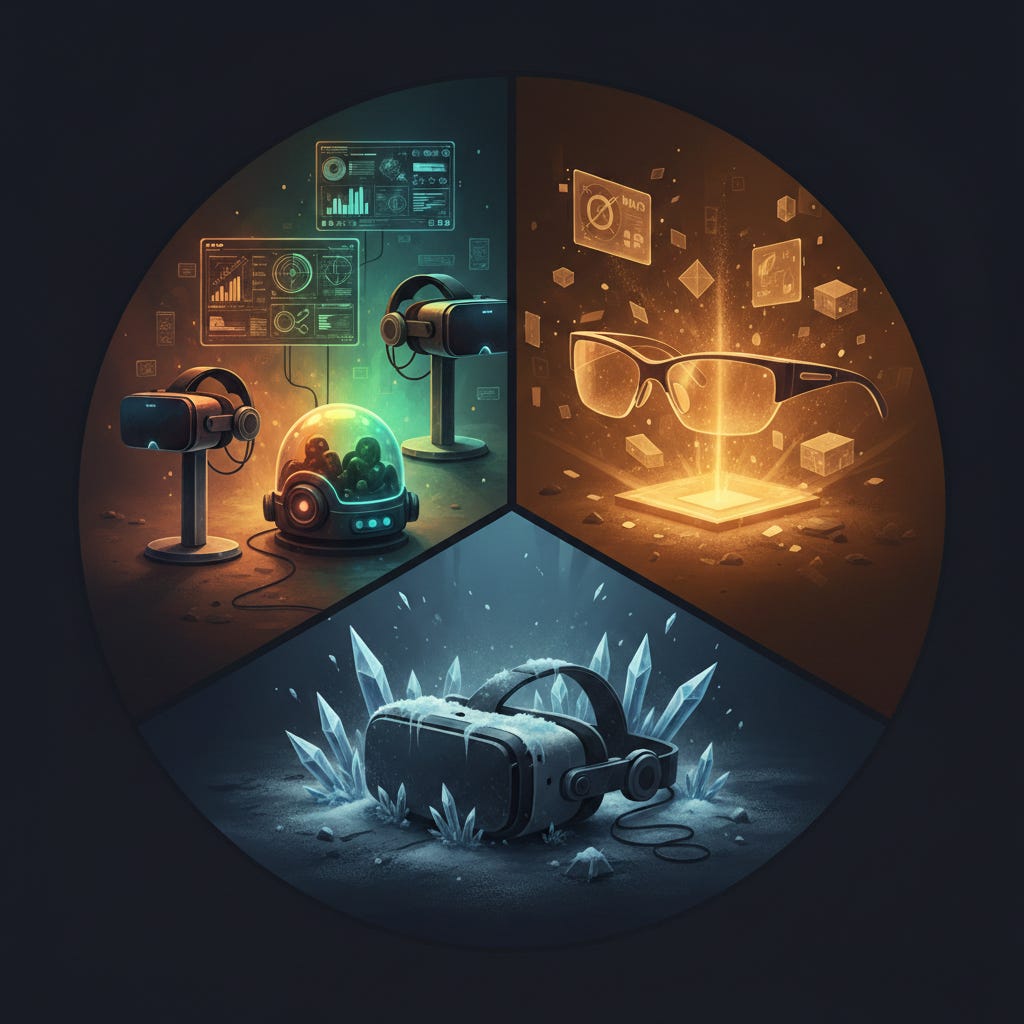
Leveraging The XR Industry Split
How to navigate the XR 2026 industry rationalization, and where to focus your efforts!

Few weeks ago, I wrote about Meta’s Reality Labs layoffs. Here are more pointers to the market rationalization we’re witnessing:
Snapchat just spun out its AR glasses into a standalone company, “Specs Inc.” A dedicated subsidiary, hiring 100+ people, and consumer launch confirmed for 2026. Snap is betting that AR glasses will become are a platform.
Google and XREAL deepened their Android XR partnership with Project Aura: compact, tethered-puck-powered AR glasses targeting this year. This matters because Android XR is an open platform, the same play Android made for smartphones. Multiple manufacturers, shared ecosystem, broad adoption. Samsung is coming too with their own Android XR device. We might be looking at the “Android moment” for AR glasses.
Not really related to market adoption, but Valve might face shipping delays of their new standalone VR devices due to a memory shortage. No firm dates, no firm pricing. Still targeting H1 2026, but the uncertainty is telling.
Developer forums are still filled with “VR winter” anxiety. Meta’s VR game studios (Armature, Sanzaru, Twisted Pixel) are gone. Horizon Worlds pivoted to mobile. The era of big-budget VR consumer content bets from major platforms is winding down.
And yet, the hardware innovation pipeline is alive — Hypervision just demoed 220° FOV VR optics at United XR Europe. VR technology isn’t stagnating — the business model for consumer VR is.
The thesis I laid out in last years’ XR & AI Trends whitepaper is playing out in real time: AI is the brain, XR is the body. And the body is getting lighter.
The bifurcation
Here is my analysis. I see two distinct markets emerging from what used to be one.
VR: becoming a specialized tool
VR is becoming what it was always best at: training, brand experiences, location-based entertainment, industrial simulation. High-value, specific use cases. Not mass consumer daily use.
Enterprise training: Pfizer, Walmart, and countless others others are seeing measurable ROI in VR training programs.
Brand experiences: pop-ups, events, showrooms where you control the environment and can justify the hardware
Location-based entertainment: immersive centers, attractions, experiences people travel for!
Industrial simulation: architecture, engineering, medical…
These work because someone else manages the hardware, the environment is controlled, and the experience justifies the friction of putting on a headset.
What VR won’t be (yet): a mass consumer daily-use platform. The install base will grow, but slowly, driven by niche usages like gaming, social or fitness users, not by mainstream adoption.
AR/AI glasses: becoming the consumer mass market product
AR glasses are becoming the consumer play. Lightweight, AI-powered, utility-first. You wear them all day. They help you, not entertain you.
Meta Ray-Ban’s success wasn’t about augmented reality overlays. It was about having an AI assistant on your face that can see what you see, hear what you hear, and respond naturally. The “AR” part (visual overlays, spatial computing) is coming, but the AI utility is what’s driving adoption today.
This is why Snap, Google, Samsung, and a dozen startups are all converging on the same form factor: lightweight glasses with cameras, mics, speakers, and AI. Some will add displays. Some won’t. But all of them will be AI-first.
The “metaverse” vision with headsets is gone. What’s replacing it is more interesting: ambient intelligence (yes, A.I. acronym pun intended) on your face, powered by AI, blending into your daily life. Maybe that’s a more accurate version of an interconnected Metaverse?
Your strategy from now on:
For brands and marketers, this means two parallel strategies:
VR/MR for deep, controlled, high-impact brand experiences (pop-ups, events, showrooms, internal tools)
AR/glasses for everyday touchpoints (try-on, navigation, contextual information, spatial commerce)
Two strategies. Two timelines. Two budgets.
If you’re a brand exploring immersive experiences, stop treating “XR” as one thing. It’s two.
For VR: Build for controlled environments where you own the hardware and the experience. Events, pop-ups, showrooms, training. The ROI is proven. The market is mature. Just don’t expect your customers to buy headsets to experience your brand at home.
For AR glasses: Start watching. The consumer devices shipping in 2026 will define what’s possible for the next 3-5 years. Think about what your brand looks like when it exists as a spatial layer on top of reality.
For both: AI is the thread that connects everything. Personalized experiences, adaptive content, real-time interaction. Whether it’s a VR training module or an AR shopping assistant, AI is what makes it smart, not just immersive.
The XR industry isn’t dying. It’s growing up. And like most things that grow up, it’s becoming more complex, more specialized, and ultimately, more useful.
Which side of the bifurcation are you building for? I’d love to hear how this split is showing up in your work. Reply to this newsletter or find me on LinkedIn.